Know what your local competitors changed this week — prices, services, hires, reviews — and what to do about it.
The competitor down the street cuts a price or starts a promo — and you hear about it weeks later, from a customer.
We do that market research for you: one short email on the days you pick, from public information only.
Free · no credit card · no annoying sales calls
- An antique store near Kansas City, MO restructured its dealer pages and added a dealer portal
- A beauty salon near Overland Park, KS added robotic massage and an app booking push
- A vacuum sales and repair shop near Olathe, KS added an in-store-only sales policy and one-year warranty
- A restaurant near Austin, TX overhauled its menu with a new prix-fixe and cocktail list
- A plumbing company near La Vista, NE added garbage disposal service and upfront-pricing messaging
- A fast food restaurant near Nebraska City, NE brought back a limited menu item with a new sauce
- An auto repair shop near San Jose, CA pushed a 25% off first-three-months promo and walk-in service
Real changes from recent briefs and free demos · names hidden
Rather look first? See a sample brief — no typing →
🔒 We only read public info — websites, reviews and listings. Nobody is contacted, and your competitors never see who asked.
Watching competitors by hand, a short history
Keeping an eye on competitors is easy to plan and hard to keep doing. Most days nothing has changed, so it quietly stops, right up until the day something big does. MyIntelBrief checks every night, so you don’t have to.
Meanwhile, at the competition…
Real lines from our sample briefs (illustrative businesses).
Self storage · Katy, TX
Across town, the 10×10 just dropped from $149 to $119, and the first month is $1.
The unit is 10×10. The fine print is 2×2.
Read this brief →Law firm · Brooklyn, NY
A rival firm built a page just for injured rideshare drivers, in English and Spanish.
Nobody announces a new practice area. They just quietly publish a page.
Read this brief →Franchise · Indianapolis, IN
The chicken place half a mile away is adding a second drive-thru lane.
Construction fencing is the loudest announcement there is. You just have to drive by it.
Read this brief →Roofing · Oklahoma City, OK
Out-of-state storm crews are knocking on doors in your town, pitching “free” hail inspections.
They’ll be gone before the next storm. Your reviews won’t be.
Read this brief →Marketing agency · Nashville, TN
A rival agency launched “AI search optimization” and posted 2 SEO job openings the same week.
One new page is a test. A new page plus two new hires is a plan.
Read this brief →Real estate · Boise, ID
A rival team now promises: “We’ll buy your home if it doesn’t sell.”
Bold promise. We read the asterisk for you.
Read this brief →Plumbing · Anaheim, CA
A rival is offering service techs a $3,000 sign-on bonus.
Your best tech has already seen the ad. Now you have too.
Read this brief →Restaurant · Mesa, AZ
Same pho, $2.30 more if it arrives by scooter.
They raised delivery-app prices about 15%. The counter price didn’t budge.
Read this brief →Dental · Seattle, WA
The chain down the street cut new-patient exams from $79 to $39.
We brush up on their prices so you don’t have to.
Read this brief →Auto repair · Columbus, OH
Oil changes across town: $89.99 → $59.99. Check-engine diagnostics: $129 → $49.
Somebody’s getting slippery.
Read this brief →Coffee shop · Asheville, NC
The 16 oz latte next door dropped from $5.25 to $4.50.
75¢ cheaper. 100% smugger.
Read this brief →Boutique · Charleston, SC
A rival boutique cut its free-shipping threshold from $150 to $75.
Your customers noticed at checkout. Now you know too.
Read this brief →Med spa · Eagan, MN
The local leader has 1,172 Google reviews. You have 56.
Now you know what next quarter is for.
Read this brief →Now see what yours are up to ↑
Is $39.99 a month worth it? Do the math with your numbers.
Knowing first means you can answer before your customers drift: a pickup reminder when a rival raises app prices, a written all-in quote when one advertises a lower headline price. So the question is simple: what is one customer, job or client worth to you?
times a year.
Tip: for a fair test, use what you keep after costs (food, parts, labor), not the full ticket.
Your numbers stay in your browser. We can’t promise you’ll keep a customer. We can promise you’ll know what changed in time to decide. The first 4 weeks are free.
How it works, in three panels
- 1,800+
- competitor briefs generated
- every brief generated — emailed, free demos, or read on the web
- 1,300+
- competitors tracked
- found from Google listings for the businesses we’ve briefed
- 890+
- competitor moves caught, last 30 days
- price, promotion, review, hiring and opening changes

Look up your business and it shows up on this map within 24 hours. We never show your business name, only your city and state.
This week: 72 briefs emailed · 211 competitor moves caught · as of Oct 18, 2026
What gets watched
What gets watched
- prices & offers
- services & locations
- reviews & reputation
- hiring & growth signals
- new competitors, permits & local news
- what your suppliers are charging
📅 The free demo is a one-time snapshot of today. A plan keeps watching and emails you each change on the days you pick.
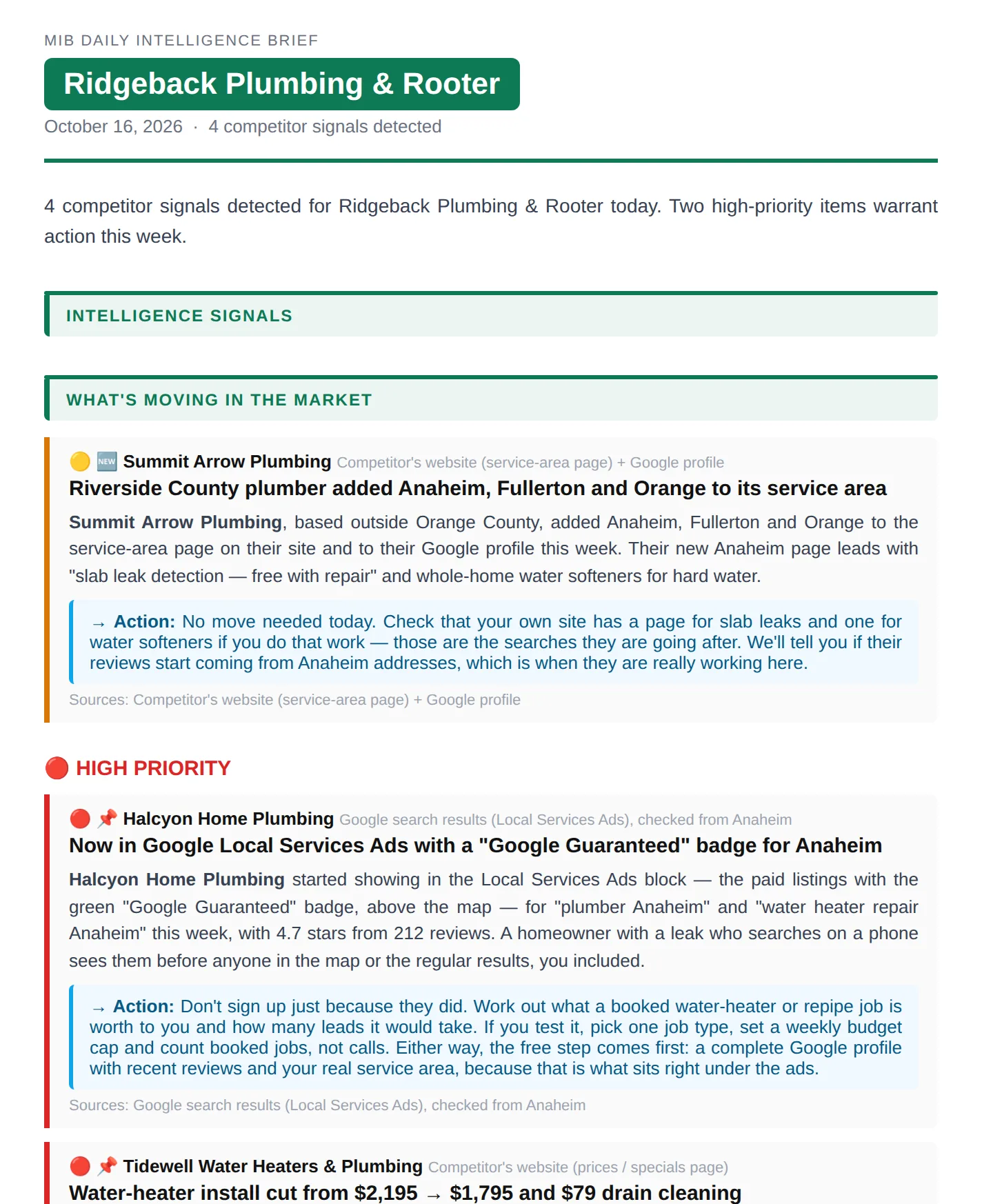 Read the whole brief →
How we pick your competitors → Competitor price monitoring →
Who it’s for
- Home services & trades
- Restaurants & food
- Med spas, dental & clinics
- Law firms
- Real estate agents
- Franchise owners
- Auto repair
- Shops & retail
- Marketing agencies & consultants
Consultants: resell these briefs under your own brand →
If your business is not listed, there’s a good chance we can do the report — we just can’t include every business or the web page would be overwhelming.
Is this just a Google Alert?
No — a Google Alert can only match a name that is already being published. We read the pages themselves — pricing, hours, reviews, job posts, permits — and report what changed, not what got mentioned.
Isn’t this just a page-change alert?
A page-change alert tells you that a page changed. We read their pages, listings, job posts and reviews together, tell you what the change means for you, and give you one move to make.
Can’t I just ask ChatGPT?
With ChatGPT, you get one undated answer, at the moment you happen to ask. We check their key pages every morning, compare them with the last copy, and report only the difference.
What it costs
Free for 4 weeks — just your email, no card. Then from $39.99/mo if you want to keep it.
Still have questions? Watch the 9-minute tour or play the podcast.
Run one on your own business
Free · no credit card · no annoying sales calls