Prices, offers and packages
Competitor price monitoring, done for you
When a rival cuts a price, starts a promotion or changes a package, you usually hear about it from a customer. MyIntelBrief does the competitor price monitoring for you: every night we compare the competitors around you against yesterday, and your morning brief shows only what changed — the before, the after, and one suggested move.
What we watch on competitors’ prices
Prices are where it starts. Competitor price tracking here is not a spreadsheet you refresh — it is part of everything that gets watched for you, every night, across the competitors around you.
Price & offer changes
A rival cuts a price, starts a promotion or changes a package — you see the before and the after, like $189 → $99.
Services on their own site
A new service line, or a change to what they say they offer on their own site.
What your suppliers are charging
Local market changes are watched too: new competitors opening nearby, permits, local news, and what your suppliers are charging.
What to do next
Each finding comes with one suggested move — often not the obvious one. “Don’t match the price” is a real answer.
Price moves are one part of the picture: reviews, hiring and local news are in the same brief. How our competitor monitoring works covers the rest.
What a price change looks like in a brief
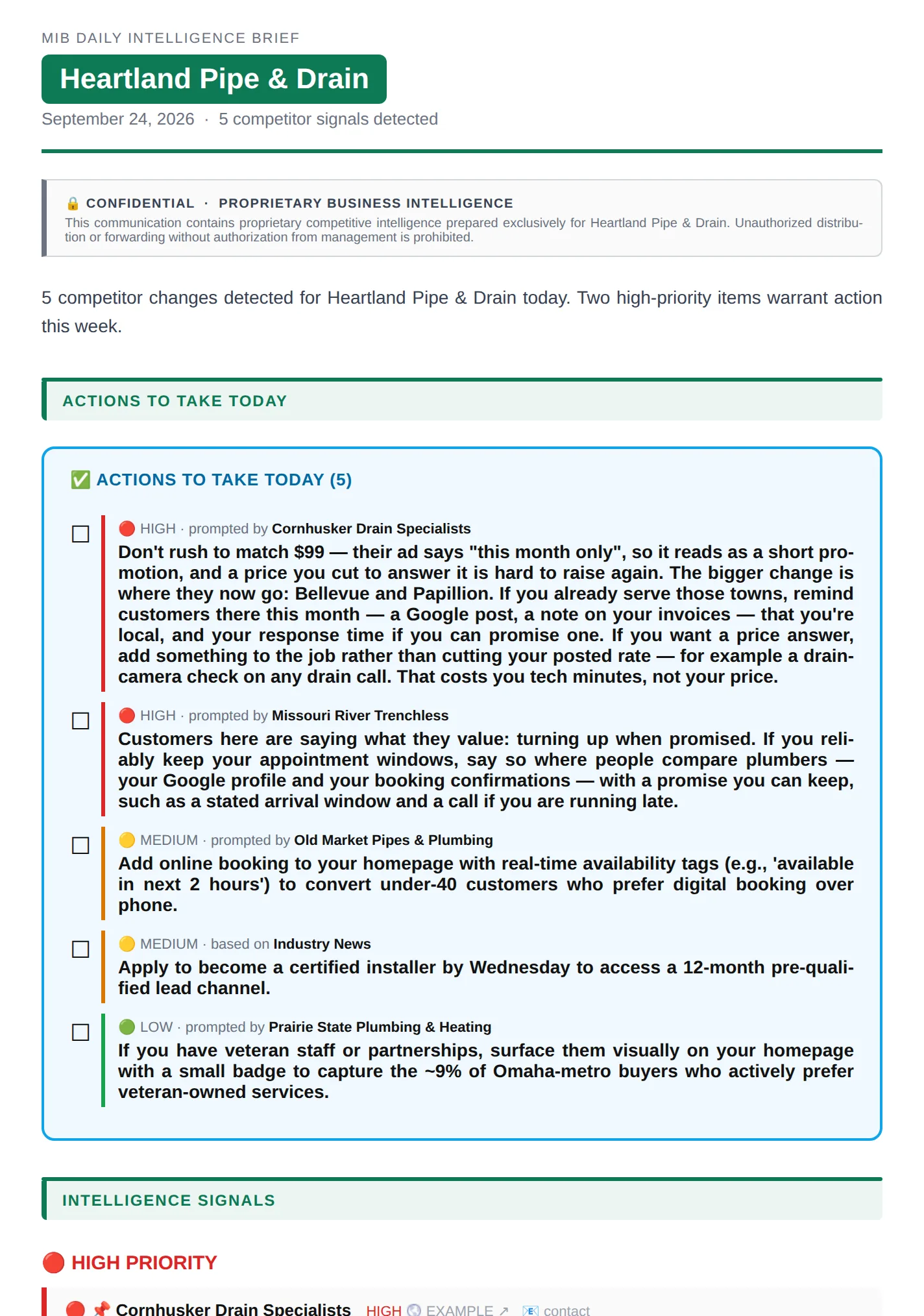
This finding is copied from a published sample brief for a plumbing contractor in Omaha. The business is illustrative.
Drain cleaning price dropped from $189 → $99 (limited-time offer)
Cornhusker Drain Specialists
Why it mattersAd copy says “this month only” but no end date shown. Their service-area radius also expanded to include Bellevue and Papillion. Aggressive price + territory move likely targets summer demand.
Suggested moveDon’t rush to match $99 — their ad says “this month only”, so it reads as a short promotion, and a price you cut to answer it is hard to raise again. If you want a price answer, add something to the job rather than cutting your posted rate — for example a drain-camera check on any drain call.
Notice the move is not “match it.” Tracking competitor prices is only half the job; the other half is deciding whether a change deserves a response at all. Read the full plumber sample brief.
Why checking by hand, Google Alerts and AI prompts miss price changes
Checking their sites yourself means opening a dozen competitor sites and comparing them line by line — and remembering what they said last week.
A Google Alert can only match a name that is already being published. We read the pages themselves — pricing included — and report what changed, not what got mentioned.
Asking an AI assistant may well get you a price, but not a date on it — you cannot tell whether it is from this morning or last quarter. Acting on an undated number is the part that costs you. And nothing is watching between your questions, so nothing can tell you the price changed.
We keep a dated copy of every competitor page, every morning, and report only the difference — $16 became $18.50 on Tuesday, the happy-hour page came down. That is an archive problem, not a writing problem, and it is why this is a standing service rather than a prompt you run once. The full comparison walks through every do-it-yourself method.
What you get
A brief waiting in your inbox in the morning: one page, ranked by what matters, a source on every claim and one suggested move. Quiet days stay short. You confirm who you’re watching first — add anyone we missed, drop anyone who isn’t really a rival. Not sure who that is yet? Start with finding your local competitors.
Price monitoring is one piece of our market research services for small business. Plans and the 7-day trial are on the pricing page — the trial asks for a card, and nothing is charged until day 8.
Frequently asked questions
- Can’t I just ask ChatGPT what a competitor charges?
- Ask a general assistant what a competitor charges and you may well get an answer. What you will not get is a date on it. You cannot tell whether that price is from this morning, from last quarter, or from whenever the tool last looked — and it will not tell you, because it does not know either. Ask again next month and nothing can tell you the price changed, because nothing kept yesterday’s copy to compare against. We keep a dated copy of every competitor page, every morning, and report only the difference.
- Is this just a Google Alert?
- No — and the gap is the point. A Google Alert can only match a name that is already being published. We read the pages themselves: pricing, hours, reviews, job posts, permits — and report what changed, not what got mentioned.
- Why is the free preview brief dated 60-90 days ago?
- The public demo and the emailed preview run on an intentionally delayed historical snapshot, so a date it mentions may already be in the past. That is expected, not a bug — serving live data publicly would give away the current intelligence our subscribers pay for. The real product delivers today’s data every morning. Your free 7-day trial lifts the delay and the name masking together.
See a free competitor brief for your business
No signup, no card. Type your business name and pick it from the dropdown. The free preview runs on a snapshot dated 60-90 days back, with competitor names masked.
Rather look first? Read the plumber sample brief.