How our competitor monitoring works
The demo shows you what you get. This is how it works — the three steps, the six stages in detail, what a full brief covers, the two ways owners use it, why your competitors stay in the dark, and how your data is kept safe.
The system
How the ongoing service works
Your competitors leave signals everywhere — a new price, a fresh review, a hiring post, a permit, a news mention. On their own, they're noise. We turn them into a decision.
Confirm who you’re watching
We find the competitors around you from public sources. Add anyone we missed, drop anyone who isn’t really a rival, and choose which days it arrives.
We read the market overnight
Their pages, listings, prices, job posts, reviews, permits and local news are compared against yesterday. Only what changed survives.
Your brief is waiting in the morning
One page, ranked by what matters, a source on every claim and one suggested move. Quiet days stay short.
A price hike plus a pulled discount plus a bad review isn't three facts — it's a story. We read what changed and why it matters to your business.
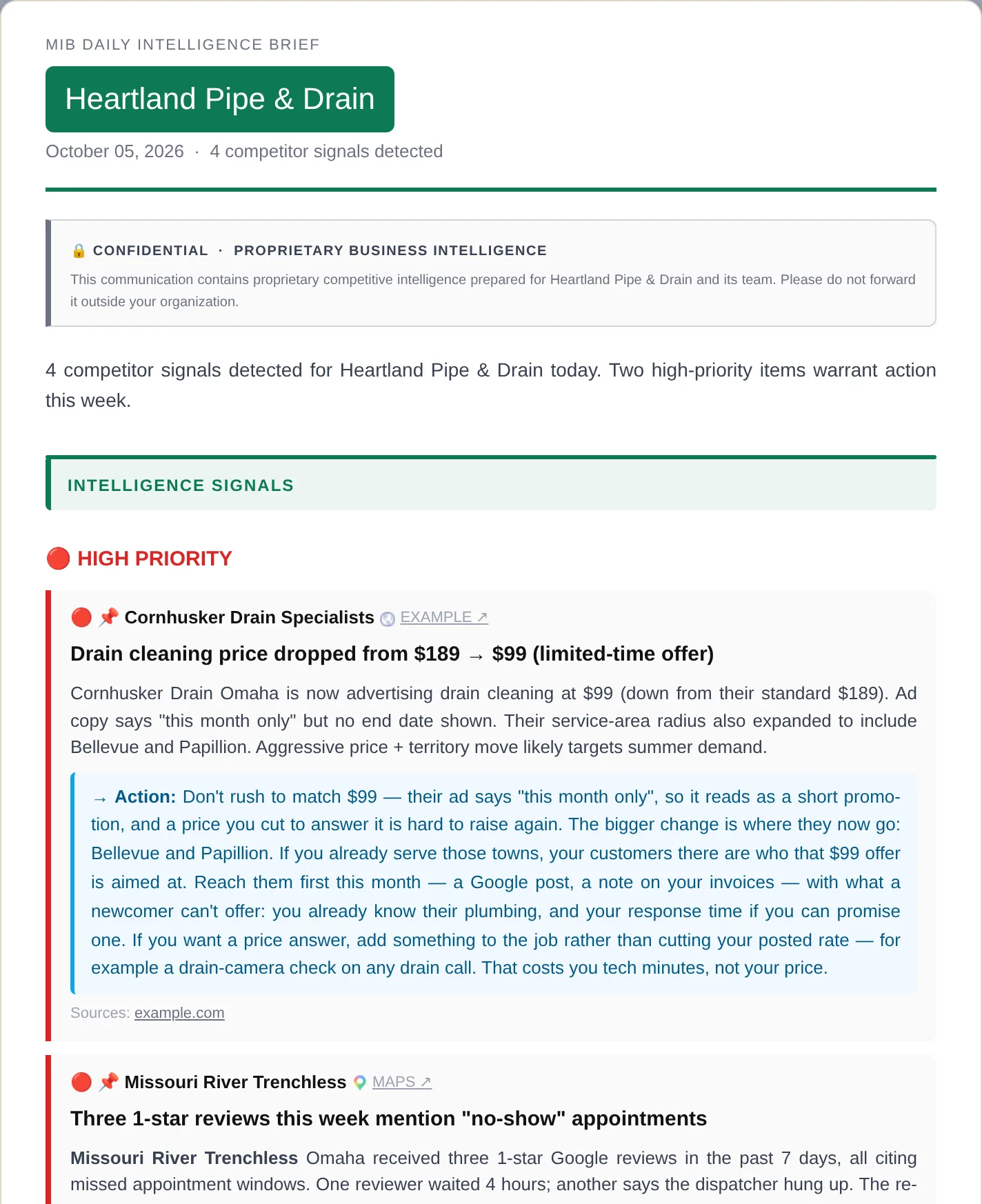 Read the whole brief →
Step by step
How it works in detail
What happens after you run it
Six stages. You do three of them, once. The other three happen every night while you sleep, and keep happening.
-
1
You · 1 minute
Run the demo
Type a business name. No signup, no card. About two minutes later you have a real brief on that market from today’s public data, with your real nearby competitors named — a one-time snapshot.
-
2
You · 3 minutes
Pick a plan
Having already read a real brief, you choose how much market to watch — from $39.99/mo for one business. That is the last decision you make.
-
3
You · once
Confirm who you are watching
We find the competitors around you from public sources and show you the list. Add anyone we missed, drop anyone who is not really a rival, and choose which days the brief arrives.
-
4
Runs without you · nightly
Overnight, we read the market
Every competitor's public pages, listings, hours, prices, job postings, reviews, permits and local news — read and compared against yesterday. Only what changed survives, so a quiet night is a short brief, not a padded one.
-
5
Runs without you · 6am
It is in your inbox before you start
Ranked by what matters, every claim carrying the public source it came from, each with one suggested move. No dashboard you have to remember to open.
-
6
You · 5 minutes
You read it with your coffee
Five minutes, and you know what moved in your market overnight — before a customer mentions it, and before anyone else on your street has noticed.
In your inbox
What actually lands each morning
One clean email on the days you pick (every day, Mon/Wed/Fri, or once a week) — read in five minutes, no login required. Ranked by what matters most, every signal cited to its source.
- The moves that matter — price changes, new reviews, website edits, hiring, local news, ranked high-to-low priority.
- Why it matters — the "so what," in a sentence, not a chart to decode.
- The recommended move — a specific next step for your business, tied to the signal.
- Every source, cited — click through to the exact page, review, or article we caught it on.
- What customers are saying, weekly — for local businesses with Google reviews: what your reviewers praise and complain about, what competitors’ reviewers complain about, and your Gripe Gap™ where those line up. What a Gripe Gap is →
- Recalls on what you buy — FDA, USDA and CPSC notices matched to the ingredients, materials and devices your business actually uses. How recall alerts work →
- Your editable competitor list — up to 10 on Starter, more on higher plans; add or drop anyone, anytime.
- A pause option + delivery control — choose the days and who else gets a copy.
What a full brief covers
Not an alert — a full report on your market. A real one runs about 2,000 words: nine ranked findings, this week’s local news, what your suppliers are charging, recalls on things you buy, hiring and permits near you, and where you sit against each competitor. Most owners are surprised how much of it is about their business.
Give it a month
Why one look never tells the whole story
Your first brief is a baseline — a snapshot of where your competitors stand right now. Real intelligence is about what changes: a price move, a website edit, a location closing, a rating slipping. Spotting a change means comparing two points in time, so the value starts the day we start watching and compounds from there.
And the payoff is uneven by nature. Some days are quiet, some days are big — a competitor might sit still for a week and then make three moves in an afternoon, and there's no telling in advance which day that will be. That's exactly why you shouldn't judge the tool on a single morning. Run it for a few weeks and the pattern reveals itself: you stop reacting late and start seeing moves as they happen. The first brief is a starting line, not the whole race.
Works the way you work
Two ways to use it
Just read the email
Open the brief, get the takeaways, close it. Five minutes, no dashboard, no homework. Most owners never need more than this.
Go deeper on demand
- SEO insight on where you're winning and where you're slipping.
- Local-ranking heatmaps across your whole service area.
- A Google reviews stats page tracking you against your rivals.
- See exactly where you rank in the Google Map Pack.
Are you a consultant or agency? The same intelligence goes out under your own brand to your clients — see white label plans →
Discretion by design
Why your competitors never find out
We read what's already public — the same pricing pages, reviews, and listings anyone can visit. There's no login to their systems, no contact, no footprint that points back to you. From setup to your first brief takes minutes: name your business, confirm your competitors, and the next morning the intel starts arriving. They have no idea you're watching.
Who is behind this
Who is behind this
A former defense intelligence professional — the daily brief is the format that discipline runs on. Meet the founder on /about. More about who we are and who we serve →
Security first
Built by someone who takes your data seriously
Because of that background, the security isn't an afterthought. Your account, your competitor list, and your billing are protected the way sensitive data should be.
We monitor your competitors — never sell your data, and never tip anyone off that you're a customer.
Ready to see it on your own business?
Run a free brief in about 2 minutes — no signup, your real competitors.
See my free brief →