Google Maps ranking check: see your real position, block by block
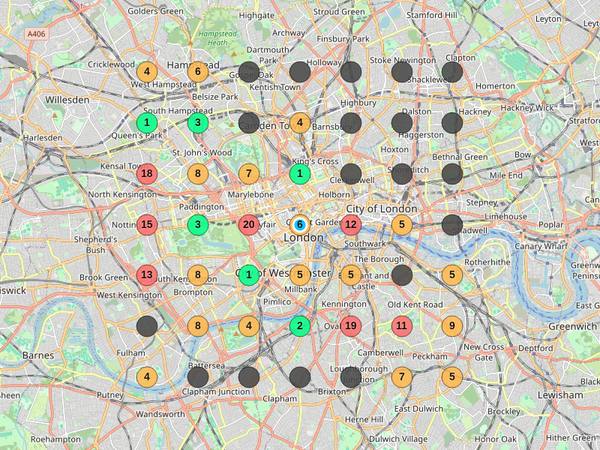
A Google Maps rank checker that finds the position your business actually holds — measured at 49 separate points across your service area, because the rank a customer sees depends on where they are standing.
Check my ranking — $16, once →🔴 The 49-point grid is a paid scan — it costs real money to run against Google, so it is not part of the free demo. No subscription; one brief, one price. Want to see the rest of the report shape first? Run the free demo — it covers competitors and services, but not the heatmap.
How the check works
- You type your business name; we match it to your real Google listing.
- We derive the search terms your listing should be found for.
- We check your position at 49 points spread across your service area.
- You get the grid, the average position, and the share of points where you land in the Map Pack.
Why a single rank number is misleading
Google Maps results are location-dependent. A business can sit in the top three for someone a block away and be invisible to someone a mile away — both are “your ranking.” A single averaged number blends those together and hides the gap, which is the part you can actually act on.
The grid shows the shape of it: which directions you own, and which ones a competitor owns.
What the $16 brief includes besides the rank check
The heatmap is the reason this is a paid scan: 49 grid points × three keywords is a real query cost against Google every time it runs. It arrives inside the one-time brief, alongside everything else — this list is taken from a real delivered brief, not a feature sheet:
- The Google Maps heatmap — the 49-point grid for three keywords, with average rank and the share of points where you appear in the Map Pack, plus an interactive version.
- What your competitors just changed — pricing, offers, hours, new pages and programming, each with its source link.
- A services comparison matrix — what every competitor advertises on their site, side by side with what yours does, so the gaps are obvious.
- Actions to take today — ranked, each tied to the specific competitor move that prompted it.
- News and third-party coverage about you and about them, always attributed to the source.
- Open US federal bid opportunities matched to your trade and state.
- A machine-readable .jsonl copy you can hand to ChatGPT or Claude and ask your own questions of.
See the one-time brief → — no subscription, nothing recurring.
Three ways to get it — and what each one actually includes
| Free demo | One-time brief | Subscription | |
|---|---|---|---|
| Google Maps heatmap | — | ✓ | ✓ |
| Competitor changes & services matrix | ✓ | ✓ | ✓ |
| Delivered every morning | — | — | ✓ |
| One-time briefs included | — | — | ✓ |
The free demo shows you the report shape on your real competitors, but not the heatmap — a 49-point grid across three keywords is a paid query against Google every time it runs, so it starts at the one-time brief. A subscription includes the heatmap too, refreshed as part of the daily brief, and bundles one-time briefs on top.
Rank check vs. rank tracking
A rank check is a measurement, not a fix. It is most useful compared against itself over time — the squares that turn green after you update your profile, add photos or earn reviews are the proof the work paid off. That repeat measurement is what a Google Maps rank tracker does, and it is the difference between knowing where you stand and knowing whether you are improving.
One scan tells you where you stand today. If you want it tracked over time alongside what competitors are changing, that is the one-time brief or a subscription.
Get the brief with my heatmap →Related: the full local SEO audit · how the 49-point grid works