For agencies and consultants
White labelA competitor brief for every client, under your name — so they keep renewing
Type a client. See their top 3 competitors in 2 minutes. Free, no card, nothing goes to the client.
How it works
- Add a client. We find their competitors; you confirm the list.
- We do the competitor analysis. Prices, promotions, services, reviews, hiring and news.
- From weekly to every morning, a brief under your logo — on the days you pick. Each new client’s briefs come to you first; once you switch that client on (or switch them all on at once), they go out on their own.
See a sample in your clients’ trade: plumbing · garage doors · HVAC · pest control · locksmiths · movers · house cleaning · self storage · orthodontists · mortgage
Try it on your clients
Local or national clients: we look for the competitors that fit each one, and you can change the list.
Free on 3 clients · 4 weekly briefs each · nothing reaches a client until you switch it on · no card
A monthly summary for every client, ready for your report. One email per client each month: what their competitors changed, with dates and sources. Sent to you only, never to the client.
One plan fee plus a small fee per client, monthly, cancel anytime · see pricing ↓
Bringing a whole book of clients? On a plan, upload a spreadsheet of up to 100.
Marketing your own company? See it on your own business →
Built by a former defense-intelligence systems engineer. Every finding names its source and date.
Illustrative: three client streets this week, from the white label sample briefs below.
Your roofing client, Oklahoma City
- Your client
- Storm crews pitching “free” hail inspections
Your manufacturing client (B2B), Grand Rapids
- Rival hiring 3 regional sales managers
- Your client
Your dental client, Seattle
- Your client
- Added Saturday and Sunday cleanings
White label samples by trade: dentist · restaurant · roofer · law firm · B2B manufacturer · more trades
Marketing intel samples by trade: dentist · restaurant · roofer · law firm · B2B manufacturer · more trades
Already send clients SEO reporting? See how this fits beside it as a white label SEO report on their competitors.
— show me a sample
Watching competitors by hand, a short history
Watching competitors is easy to promise and hard to keep up. Most days there’s no needle in the haystack, so it quietly stops. If it’s part of what your client pays for, it has to happen on the quiet days too. MyIntelBrief checks for every client on the days you pick, with the brief ready by morning, and without you or your staff.
What's in the white label plan
Your brand on every brief
Briefs come to you first
Agency-only marketing intel
Team logins and activity log
Add 100 clients at once
15 more features
Review replies: an easy weekly win
Own-listing watch
Competitor history and trends
“See the change” pictures
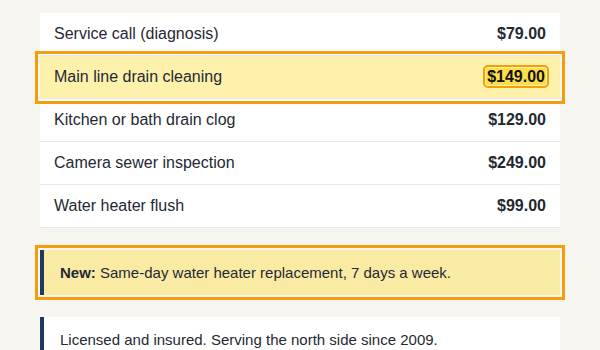
Monthly scorecard for renewals
Preview it with your logo
Runs on your meeting day
White label SEO report
Prep sheet before client calls
Monthly and yearly summaries
Ready for your AI assistant
Hide what you already sell
Fix a wrong competitor fast
Founding agencies: custom workflows
Contracts and your data
Your client has seen your name on their competitors' moves week after week since month one. The renewal answers itself.
And you bring the proof: a 12-month summary for each client, the biggest dated, sourced competitor changes caught for them and a month-by-month count, under your brand, one click from their client page.
What your client receives
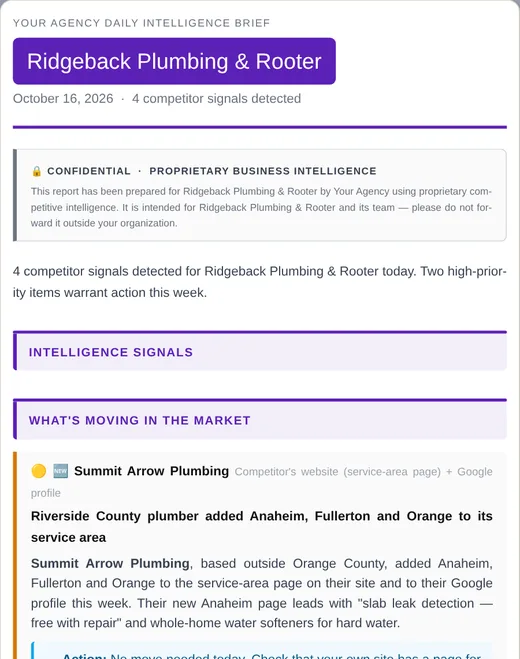
From a sample brief for Ridgeback Plumbing & Rooter, a plumber in Anaheim (illustrative business):
-
Prices · their competitor Tidewell Water Heaters & Plumbing
Water-heater install cut from $2,195 → $1,795 and $79 drain cleaning
-
Hiring · their competitor Kestrel Rooter & Drain
Hiring 2 service techs with a $3,000 sign-on bonus
-
New competitor · Anaheim
Riverside County plumber added Anaheim, Fullerton and Orange to its service area
Each brief also carries review standings, regulatory news, a weekly SEO audit, local map-pack ranking and, once a week, the Gripe Gap™ (simply “Gripe Gap” under your brand).
Also in the client’s brief: an alert at the top if their own Google listing shows closed or its details change; a small picture of a rival’s changed page with the change highlighted; and a scorecard against each rival in the first brief of every month. New reviews still waiting for a reply, each with a suggested reply, come to you; one setting adds them to the client’s brief. Law and healthcare get a neutral reply that never confirms a client or patient.
 View a Full Sample Brief →
The Gripe Gap™: what your client’s customers love about your client that their rivals’ customers hate about them, and how your client can use it to their advantage
We do this analysis for you. Every week we read the public Google reviews for your client and the rivals near them, and when the data shows an edge, where your client is praised and the competition is complained about for the same thing, we find it and put it in the brief. If the data holds no edge, we don’t make one up. Here is how it works, on a sample plumber.
-
Step 1 · Their praise
Your client’s reviewers keep saying the same good thing
We read the reviews and group what people praise.
Ridgeback Plumbing & Rooter, Anaheim
★★★★★“The price on the quote was the price on the bill.”★★★★★“No surprises. Exactly what they quoted.”★★★★★“Honest about the total up front.”8 reviews praise “the price on the quote was the price on the bill”
-
Step 2 · Their gripes
The rivals’ reviewers keep saying the same bad thing
Same reading, for the 3 competitors nearby.
3 nearby competitors
★☆☆☆☆“Surprise fees on the invoice.”★★☆☆☆“Final bill was way over the quote.”★☆☆☆☆“Extra charges nobody mentioned.”13 reviews complain about surprise fees
-
Step 3 · The gap
Where the two meet is your client’s edge
When your client’s edge is in the review data, we find it and say it in plain words.
Praised here
honest totalsGripes there
surprise feesGripe Gap™Your client is praised for the exact thing the rivals’ customers complain about.Suggested move: Say it where buyers compare: put what the quote includes in writing, so a homeowner holding two quotes can see it.Counted from public Google reviews, source named on every finding.
Illustrative business and counts, from the sample brief on this page. Once a week, in every brief, written for your real business and your real competitors.
Meanwhile, at your clients’ competitors…
Real lines from our white label sample briefs (illustrative businesses). Your client reads them under your name.
Your roofing client · Oklahoma City, OK
Out-of-state storm crews are knocking on doors in your client’s town, pitching “free” hail inspections.
Your client hears about it from you, before the homeowners sign.
Read this brief →Your manufacturing client · B2B
Their rival posted 3 regional sales manager jobs, in territories where it has no dealers today.
Three new territories in one week isn’t a coincidence. It’s a plan.
Read this brief →Your med spa client · Eagan, MN
The local leader has 1,172 Google reviews. Your client has 56.
Congratulations: you just found next quarter’s project.
Read this brief →Your plumbing client · Anaheim, CA
A rival is offering service techs a $3,000 sign-on bonus.
Your client’s best tech has already seen the ad. Now your client has too.
Read this brief →Your dental client · Seattle, WA
A rival practice just added Saturday and Sunday cleanings.
Weekends used to be your client’s quiet advantage. Used to be.
Read this brief →Your restaurant client · Mesa, AZ
Their rival raised delivery-app prices about 15%, but not at the counter.
Same pho, $2.30 more if it arrives by scooter.
Read this brief →What your agency sees for the same six clients (marketing intel, agency only): roofer · manufacturer · med spa · plumber · dentist · restaurant
Your logo. Your colors. Your reply-to.
Nothing on the brief says MyIntelBrief. Your client sees your firm doing the watching, and we’re happy backstage.
How the money works
- You pay us a wholesale fee for the service: your plan, plus a fee for each client business. Your plan fee is $99.99 a month while you have fewer than 5 clients, then $209.99 (it moves when you add your 5th client, prorated). Every client costs you less than $34.00 a month, under $1.12 a day for a client to have the intel. That’s the ceiling: your actual per-client price is lower and drops as you add clients. The full price list comes by email: get it by email (no card).
- You decide how your client pays. Bill it as its own line item at your price, or roll it into their monthly retainer.
- We never bill your clients or contact them about money.
- Nothing reaches a client until you switch it on. Each new client’s briefs come to you first; once you switch that client on (or switch them all on at once), they go out on their own. A brief takes a few minutes to read, and every line links to its source. A simple rule: read a new client’s first 2 or 3 briefs, and if none needed a fix, switch that client on and spot-check from then on. You never have to switch a client on: many agencies stay the go-between for good, forwarding each brief themselves, so the client hears every move from you first and you’re the one who always knows their market.
- Your team’s AI assistant can read every brief. Each item is tagged, so an assistant can draft the competitor section of a client’s monthly report and its to-dos without anyone reading the brief line by line. White label client copies carry no MyIntelBrief file, header or link. Schema
The most it can cost you, per month (an upper bound, not your price)
Pro plan with white label $209.99 + clients × $34.00 = at most $549.99
Each client gets the intel for under $1.12 a day, at most $1.81 a day all-in with the plan fee.
$34.00 is the ceiling, not the rate: every client costs less, and the per-client price drops as you add clients, so your real total is lower than this. The exact all-in total for your number of clients is in the full price list by email. Pay the plan yearly and the standard plan fee is about 16% less (two months free; the under-5 plan fee is monthly only).
Every client costs less than $34.00 a month, and the rate drops as you add clients. Enter your email and we’ll email you the full per-client price list (1 to 100 clients). It goes to your agency’s own email address: no card, no call.
Want it on screen right now? Sign in free (email or Google) for the same table plus a calculator.
Never patient data. We don’t collect, store or process patient information: no PHI, ever, so no BAA is needed.
Paperwork, before you sign anything: Data Processing Agreement (PDF) · who handles your data · procurement one-pager
Plans
The plan fee buys your workspace and the white label program. Each client business is priced separately, cheaper the more you add.
No sales calls unless you ask for one. Sign up online, on your own time.
Includes 20 full prospect briefs every month: walk into the pitch already knowing their market.
Free to start: 4 weekly briefs on up to 3 of your clients
Just your email — no card, no plan. Today’s data, the client’s competitors named. The free briefs say MyIntelBrief unless you put your firm’s name and color on the demo’s brand preview, or sign in and add them with your logo. Free briefs come only to you. A plan puts your brand on every brief sent to your clients, up to every morning, and adds the local heatmap. Run it on a client →
$99.99
plan fee per month while you have fewer than 5 clients (covers 1 business of your own) · founder rate then $209.99 a month from your 5th client (prorated)- Every client business you add, billed per client
- Plus briefs on 3 businesses of your own (your agency, or a test)
- Up to 20 competitors tracked on each
- Your brand, logo and reply-to on every client brief
- Standard support
$749.99$1499.99
plan fee per month · founder rate + each client business you add, less than $34.00 a month each- Every client business you add, billed per client
- Plus briefs on 10 businesses of your own (your agency, or a test)
- Up to 25 competitors tracked on each
- Everything in Pro white label
- Onboarding help, and a person to call
Your client list stays confidential. The full per-client price list comes to your email (no card), before you pay: get the price list.
Cancel renewal anytime. The plan buttons start a paid plan: a 7-day free trial with a card, nothing charged today. The 4 free weekly briefs above are separate and need no card. If you use them first, they take the place of the 7-day trial.
Different from what you might expect
A few things work differently from what most agencies assume. Tap any one for the details.
Your brand and your clients
You can see it under your own logo before you pay.
Nothing reaches a client until you switch it on.
It reaches your client as your firm's work.
Your clients stay your clients.
Your client list stays confidential.
Sources and your data
Every signal shows where it came from.
Public sources only.
We don’t train AI models on your data.
Day to day
Bringing a lot of clients? Upload a spreadsheet.
Already sell SEO or map-pack work? Switch those sections off.
Before each client call, one page instead of a stack.
Quiet markets get a short brief.
It works beside the tools you already use.
It keeps watching after you look away.
Setup is one form per client.
Who keeps 25 competitor lists current?
It hands you the next piece of client work.
Trying it and paying
You can judge it on a client you already have.
You set the price, and you can change course.
Why can't we just build this in house?
You can try. Here's what it takes to get it right, for every client, every week:
- Freshness. Ask an AI what a business changed and you get a mix of old and new, with no dates. Every finding has to be traced to a source and a date before it's safe to put in front of a client.
- Made-up details. Unless every prompt is tightly tailored, AI fills gaps with things that sound right and aren't. One invented "fact" in a client's brief costs you that client's trust.
- No single AI knows enough. Some models only know what they were trained on; others can search the web, and they disagree. Getting it right means running several and checking them against each other.
- The right competitors. Businesses with the same name, a bank that was bought last year, a rival two towns over that doesn't really compete. Picking the wrong company is the fastest way to lose a client's trust, and it's harder to get right than it looks.
- It never stops. Websites change, search results change, the AI models change. It all has to keep working every week, for every client, without your team babysitting it.
That's the part we've already built, and keep rebuilding. You get it under your name, from day one.
More questions: will clients know, billing, cancelling, what each brief carries →
Watch or listen: how agencies use MyIntelBriefA 7-minute video, two audio episodes (24 and 61 minutes) and a 15-page slide deck
-
Automated competitor intelligence for local businessesAudio, 24 min · Transcript
-
Corporate espionage comes to Main StreetAudio, 61 min, the long version · Transcript
-
The intel-powered agencySlide deck, 15 pages, PDF, 2.6 MB
Open the slide deck
Try it on your most technical client
The one that makes pacemaker parts, or semiconductor test equipment. You don’t have to become an expert in their field: the brief reports clearances, launches and contract wins as the trade press covers them.
-
Regulatory · direct rival
A rival’s next-generation implant cleared FDA review
-
Launch · same market
A competing system moved from limited release to full commercial launch
-
Contracts · same market
A competitor announced a new multi-year supply contract in your client’s category
Every line is cited to where it came from. Run it on your most technical client →
Run it on a client whose market you know cold. If the brief looks like a mirror, you can trust the next one. If it looks like a funhouse mirror, don't buy.
Run it on a client →Not trying it yet? What would you need to see first?
Thanks, that helps. See 32 sample briefs by trade → Enter your email in the price box and we’ll email you the full per-client price list (no card): go to the price box. Every item in a brief links the public page it came from, so you can check it. Read a full sample →