For SEO, PPC and marketing agencies, and consultants
White label SEO report on the one thing your dashboard can’t see: your client’s competitors
A white label SEO report built around rivals: where your client ranks on Google against the companies it competes with, the searches those rivals win, the ads they run, how fast every site loads on a phone, and what is quietly broken on your client’s own website. Pulled every week, ready the night before your client meeting.
What it is not: it does not connect to your client’s Google Analytics or Search Console, so it never shows your client’s measured visits or leads. Its traffic figures are estimates modelled from rankings, there to compare your client with its rivals. It is the competitive section your usual reporting is missing.
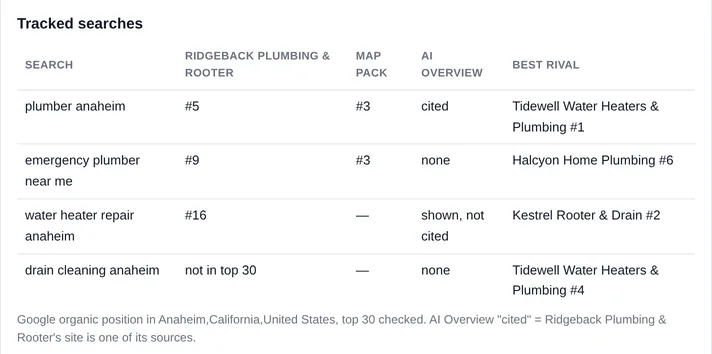
Live Google positions from the client’s own city, side by side with the best-placed rival, the map pack and the AI Overview, for the searches you choose.
White label SEO reporting you already send covers your client. This covers the street.
Your analytics-fed report answers “how did we do?” The questions clients ask in the meeting are usually about someone else.
| The question in the meeting | Where the answer comes from |
|---|---|
| How much traffic and how many leads did we get? | Your analytics report. Not this one. |
| Do they get more search traffic than we do? Is it growing? | This report: estimated monthly search visits for the client and each rival, with the 12-month trend. Estimates for comparing sites, not measured visits. |
| We’re on page one for our main search. Who is above us? | This report: the live Google position for the client and each rival, checked from the client’s city. |
| Which searches is our biggest competitor winning that we’re not? | This report: searches rivals win, with monthly volume and who holds page one. |
| Are they running ads? Since when? | This report: each rival’s live Google ads, how many are new in 30 days, and the formats. |
| Is their website faster than ours? | This report: Google PageSpeed on a phone for the client and every rival. |
| Is anything on our own site hidden from Google? | This report: noindex pages, a sitemap listing pages Google is told to skip, broken links. |
| Do AI answers mention us? | This report: whether an AI Overview appears on each tracked search and whether it cites the client. |
What’s in the report, for each client
One page per client in your agency dashboard, plus a weekly email digest. Each section names its source and when it was last pulled.
Talking points
Up to three findings worth raising at the next meeting, each with the reason it matters.
Tracked searches
Up to 20 searches you choose, checked live in the client’s city: position, change since last time, map pack, AI Overview.
Searches rivals win
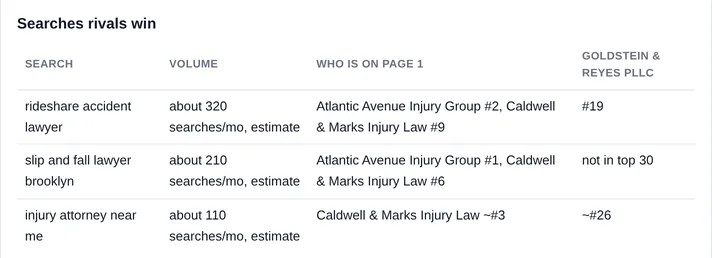
The keyword gap in plain words: commercial searches where a rival is on page one and your client is missing or far behind.
Who owns page one
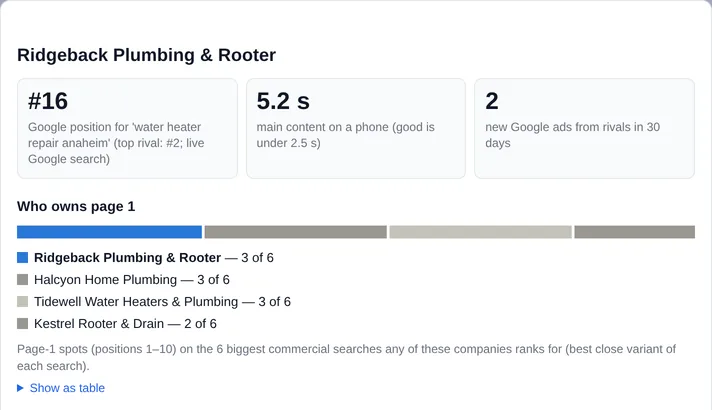
For the market’s biggest commercial searches, which companies hold the top spots.
Competitor ads
Live Google ads per rival from Google’s Ads Transparency Center, new ads in the last 30 days, and a link to each rival’s social ads.
Mobile speed
Time until the main content shows on a phone, for the client and each rival: Good, Slow or Very slow.
Homepage checklist and positioning
Tap-to-call, quote form, visible reviews, live chat, and what each homepage promises, to whom, with what proof.
Your client’s own site
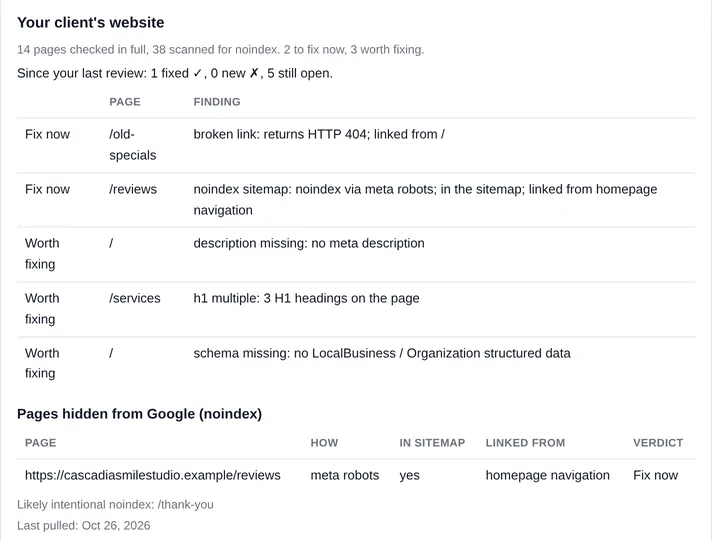
A technical and on-page audit with the page and the exact evidence for every finding, described below.
Since your last review
What moved since the previous run: positions gained or lost, new ads, speed changes, site issues fixed or still open.
Charts and a data file
Your client in blue, rivals in gray, a table under every chart, and a JSONL file with one line per finding for any AI assistant you use.
Open a full sample report
Each sample is drawn by the same page builder a real client’s report uses. The businesses are invented and the numbers are illustrative; nothing in them was pulled.
A white label SEO audit of your client’s own site, every week
The site check reads your client’s website straight from its HTML, headers, robots file and sitemap. No AI model writes these findings: each one names the page and the exact evidence, sorted into fix now, worth fixing and check this. It works as a white label website audit you can rerun weekly instead of once at onboarding.
- Pages carrying a noindex tag or header
- Pages in the sitemap that tell Google not to index them
- Pages blocked by the robots file
- Broken internal links and page errors
- Missing or duplicate titles and descriptions
- Headings, canonical tags, mobile viewport
- Mixed content and image alt text
- Structured data and social sharing tags
- Oversized pages
- Phone number on the site vs the Google listing
Pages hidden on purpose, such as member areas or staging copies, go on a per-client ignore list and stop cluttering the findings.
What goes out under your brand, and what stays with you
For your client, under your name
The white label competitor brief: your agency’s name, logo and colors, no trace of ours. It can include a weekly SEO check of the client’s site and a local map pack ranking, and you can switch either off if it overlaps with work you already sell.
For your agency only
The marketing intel on this page: a signed-in page and a weekly digest, never added to a client brief. It is the raw material for your own recommendations. Lift a chart into your deck, or hand the JSONL file to any AI assistant you use to draft the competitive section of your report.
Rolling out now, in preview, to agencies on a white label plan.
On your meeting schedule, with a dated record
Pulled the night before you meet
Pick your weekly meeting day and time zone; data is pulled around 2 a.m. the night before. Ads, phone speed and the site checks refresh weekly, rankings and positioning monthly. When you add a client, a first report for that client comes by email.
Every section shows “Last pulled” and “Next refresh”, and each weekly pull is stored with its date, so the trend charts show the history building week by week.
Everyone gets their own login
Owner, admins and members, each with their own sign-in. An Activity log records sign-ins, team changes and who opened which client’s report. Remove someone and they are signed out everywhere, with no shared password to change.
Each person can get the weekly digest for all clients or only the ones they handle.
Questions agencies ask
- Does this white label SEO report connect to Google Analytics or Search Console?
- No. It never asks for your client's analytics or Search Console access, and it never shows measured visits or conversions; its traffic figures are estimates modelled from rankings, for comparing your client with its rivals. It covers what those tools cannot see: where your client's competitors rank, which searches they win, the Google ads they run, how fast their sites load on a phone, and what is wrong on your client's own site. Most agencies send it alongside the reporting they already do.
- Is it a full SEO platform?
- No. It is a competitive SEO report: a focused set of checks on your client and its top rivals, pulled on a schedule and kept as a dated history. There is no rank tracker for hundreds of keywords and no backlink database.
- Can I send it to my client under my own brand?
- Two different things go out. Your client receives the white label competitor brief, under your agency's name, logo and colors. The marketing intel described on this page is for your agency only and never appears in client briefs; you decide what to pass on, using its charts and its JSONL data file in your own report.
- How often is the data updated?
- Your agency picks a weekly meeting day, and the data is pulled the night before. Google ads, phone speed and the website checks refresh weekly; keyword rankings and gaps refresh monthly; your tracked searches are checked on each run. Every section shows when it was last pulled and when it refreshes next.
- What does the white label website audit check?
- Page titles, meta descriptions, headings, canonical tags, the mobile viewport, mixed content, image alt text, broken internal links, page errors and oversized pages, plus robots blocking, the sitemap, structured data, social sharing tags, and whether the phone number on the site matches the Google listing. It also finds pages hidden from Google by a noindex tag, including pages listed in the client's own sitemap.
- Which searches does it track?
- Up to 20 searches per client that you choose. Until you save your own list, the client's top ten commercial searches are tracked automatically. Each is checked in your client's own city: the client's Google position, each rival's, the map pack, and whether an AI Overview appears and cites the client.
Start with one client you know well
Type in a client and see their competitors in about two minutes, free. Plans and pricing for agencies are on the white label page.